Pot Odds and Equity: The Math Every Live Player Needs
Stop guessing on draws. A clear, INR-priced walkthrough of pot odds, implied odds and equity for live cash players.

PokerhubIndia.com Editorial
Strategy desk
Most live decisions in No-Limit Hold'em come down to one question: 'Is the price I'm being offered better than the chance I have to win?' That question has a precise answer, and the players who can compute it at the table are the ones who win money over a year. This is the cleanest, simplest introduction to the math, written for Indian live cash players using INR examples you'll actually see.
What is equity?
Equity is your percentage chance of winning the pot if all cards run out without further betting. A flopped flush draw against a made top pair has roughly 35% equity by the river. A pocket pair against two over-cards (a 'race') is roughly 55–45. You don't need to memorise hundreds of matchups — you need to internalise the few that come up constantly.
The Rule of 4 and 2
The most useful shortcut in live poker. Count your outs (cards that improve you to the best hand) and:
- On the flop, multiply outs by 4 to estimate your chance of hitting by the river.
- On the turn, multiply outs by 2 to estimate your chance of hitting on the river.
Examples: a flopped flush draw has 9 outs → 9 × 4 = 36% (close to the actual 35%). An open-ended straight draw has 8 outs → 32%. A gutshot has 4 outs → 16%.
What are pot odds?
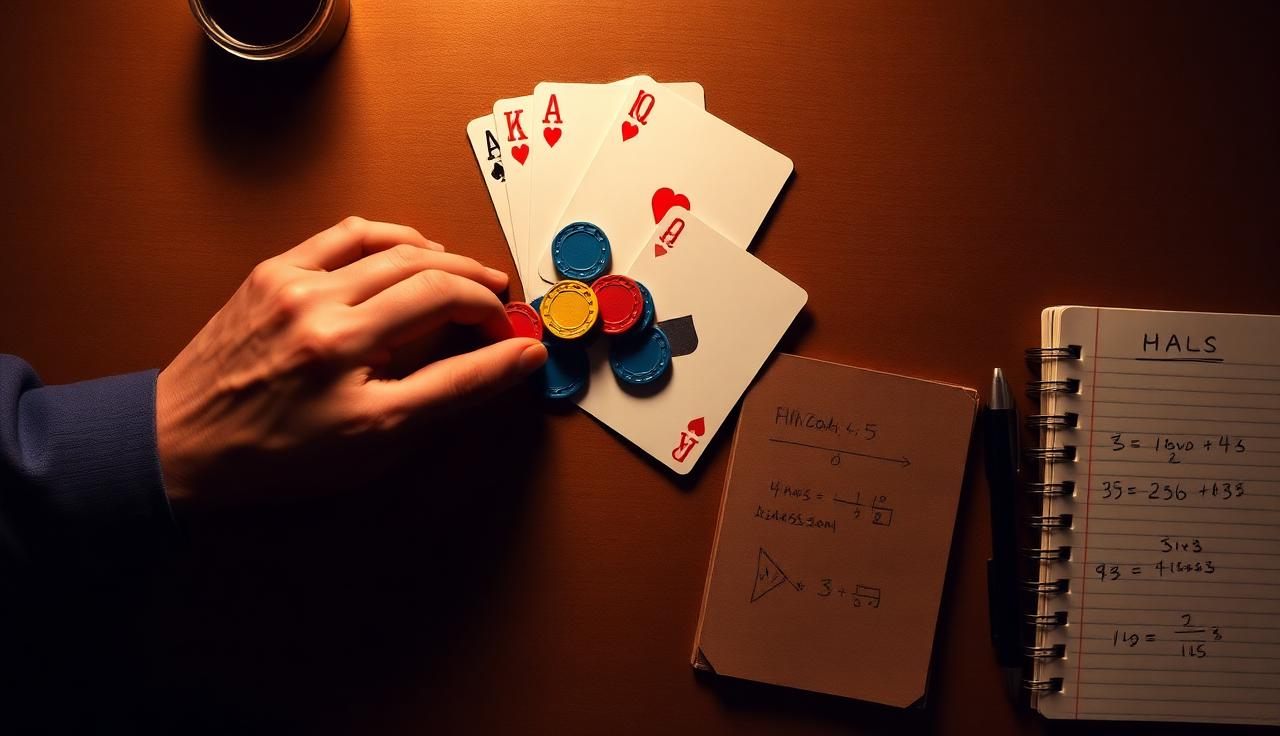
Pot odds are the price you're being offered. If the pot is ₹10,000 and your opponent bets ₹5,000, you have to call ₹5,000 to win ₹15,000 — you're getting 3-to-1, or you need to win this pot 25% of the time to break even.
The general formula:
Call required ÷ (Pot + Call required) = minimum equity to call profitably.
Plug it in: 5,000 ÷ (10,000 + 5,000 + 5,000) = 25%. If your hand has more than 25% equity against your opponent's range, calling is profitable.
Putting it together: a Gurgaon ₹25/50 example
Want game invites in your city?
Join the NCR poker community. Get vetted home games, meetups & strategy drops.
You're on the button at a Gurgaon home game, ₹25/50 NLHE. You hold T♥9♥. Cutoff opens to ₹150, you call. Flop is K♥4♥2♣. Pot is ₹350. Cutoff bets ₹250.
- Outs: 9 hearts for the flush.
- Equity by river: 9 × 4 ≈ 36%.
- Pot odds: 250 ÷ (350 + 250 + 250) = 250 / 850 ≈ 29%.
- Decision: 36% equity > 29% required → profitable call.
The decision is even better than it looks, because you also have implied odds (more on that below).
Implied odds
Implied odds are the chips you expect to win on later streets when you hit your draw. A flopped flush draw against an opponent with a strong made hand has excellent implied odds — they're likely to pay off a river bet when the third heart lands. A flopped gutshot against a thin range has poor implied odds — they'll often fold to the river bet that completes your straight.
Rule of thumb: chase draws when implied odds are good and fold when they're not. A useful proxy is stack depth. Deep stacks → good implied odds → call more draws. Short stacks → bad implied odds → fold more draws.
A cheat-sheet to memorise
- Flush draw on the flop: ~36% (9 outs).
- Open-ended straight draw: ~32% (8 outs).
- Gutshot: ~16% (4 outs).
- Flush + gutshot: ~54% (12 outs) — a monster, play it fast.
- Two over-cards on a low board: ~24% (6 outs).
- One over-card with a flush draw: ~45% (12 outs).
The discipline part
Knowing the math doesn't help if you don't use it. The reps come from forcing yourself, every hand, to count outs and compute the price before you decide. After a few hundred hands it becomes automatic. After a few thousand, you can't turn it off. That's when you've become a winning live player.
Frequently asked questions
Do I need to memorise exact equity percentages?+
No. The Rule of 4 and 2 gets you within 2–3% of the real number, which is more than accurate enough for live decisions. Memorise the common draws (flush, open-ender, gutshot) and use the rule for the rest.
How do implied odds change my pot-odds calculation?+
Implied odds let you call profitably with worse direct pot odds, because you expect to win additional chips on later streets when you hit. Add a rough estimate of future winnings to the denominator of your pot-odds equation.
Should I rely on math more than reads at live tables?+
At small-stakes live, math beats reads more often than not. Reads layer on top of the math, not instead of it. Get the math automatic first, then incorporate reads.
Does pot odds apply to PLO and other variants?+
Yes, identically, but counting outs is harder in PLO because draws are bigger and equities run closer. Most players use a simpler heuristic in PLO: combo draws of 13+ outs are usually go-with hands.
If you want to drill these reps in a friendly setting, our NCR community meetups run a low-stakes 'study cash' table specifically for practising live math without burning a bankroll.