Can police raid a private poker game in Delhi NCR? Yes, police may have legal powers to enter and search premises suspected of being used as an illegal gaming house, but whether those powers apply depends on the relevant law and the facts of the game.
A private poker game among friends, where the host takes no rake, commission or other profit, is materially different from a commercial operation that earns money by running games. However, playing in a private home does not automatically make every poker game lawful.
The legal position also differs across Delhi, Gurugram, Faridabad, Noida and Ghaziabad. Each jurisdiction has its own applicable legislation and relevant court decisions. Whether poker qualifies as a game of skill, whether the premises constitute a common gaming house, and whether the operator is earning a profit can all affect the legal analysis.
This guide examines the relevant legal framework, the distinction between a social game and a commercial gaming operation, and what players and hosts should understand before organising a private poker game.
Legal disclaimer: This article provides general information, not legal advice. The position described is based on the legal materials identified for review as of October 2026. The current status of recent Haryana notifications must be confirmed through official records. Consult a qualified lawyer for advice about a specific game or police action.
Which Gambling Law Applies in Delhi NCR?
Delhi NCR covers multiple jurisdictions. The law applicable to a poker game in Delhi may differ from the law applicable in Gurugram, Faridabad, Noida or Ghaziabad.
Location | Relevant legal framework | Important consideration |
|---|
Delhi | Delhi Public Gambling Act, 1955 | Section 13 excludes games of mere skill from the Act. Whether a particular poker game qualifies requires legal analysis. |
Gurugram and Faridabad, Haryana | Haryana Prevention of Public Gambling Act, 2025 | The Act addresses public gambling and common gambling houses. The commencement, applicable provisions and any relevant notifications must be checked. |
Noida and Ghaziabad, Uttar Pradesh | Public Gambling Act, 1867, as applicable in Uttar Pradesh | Section 12 excludes games of mere skill. The Allahabad High Court considered poker and rummy in the DM Gaming case in 2024. |
The existence of a legal argument that poker involves skill does not automatically authorise every private game or commercial poker venue. The applicable legislation, the format of the game, the way money is handled and the facts surrounding the premises remain important.
1. Delhi: What Does the Delhi Public Gambling Act, 1955 Say?
The Delhi Public Gambling Act, 1955 is central to understanding the distinction between a social poker game and a suspected common gaming house.
Section 2(1)(iii) defines a common gaming house by reference to a place where instruments of gaming are kept or used with a view to the profit or gain of a person owning, occupying or keeping the place. The definition includes arrangements involving payment for the use of the premises or gaming instruments.
You can review the official text of the Delhi Public Gambling Act, 1955 via PRS and the Delhi Police training note for further context.
What do Sections 3, 4, 5 and 6 cover?
Section 3: Addresses owning, keeping, managing or knowingly permitting premises to be used as a common gaming house.
Section 4: Provides penalties for people found gaming or present for gaming in a common gaming house.
Section 5: Sets out powers to enter and search premises suspected of being a common gaming house, subject to the statutory conditions.
Section 6: Provides that the discovery of cards, gaming tables, chips and other gaming instruments in premises searched under the Act can constitute evidence that the premises are a common gaming house, subject to the provision's terms.
Section 5 is particularly relevant to the question of police raids. It provides for action where the specified authority has credible information and reason to believe that a place is being used as a common gaming house. The provision also sets out the circumstances in which a police officer may be authorised to enter and search.
This does not mean that every gathering involving poker cards automatically meets the legal definition of a common gaming house. The facts and statutory requirements matter.
Does Section 13 protect poker as a game of skill?
Section 13 states:
"Nothing in this Act shall apply to any game of mere skill wherever played."
You can read the text of Section 13 of the Delhi Public Gambling Act for the precise wording.
The provision creates an important distinction between games of mere skill and activities covered by the Act. However, it should not be interpreted as a blanket guarantee that every poker game is exempt from police scrutiny.
The legal position of poker in Delhi must be assessed in the context of the applicable law and the specific circumstances. The absence of a state notification expressly naming poker does not, by itself, settle every question about the application of Section 13.
For hosts, the key distinction is between understanding the skill-game exemption and assuming that a private address automatically makes a game lawful.
2. Gurugram and Faridabad: Understanding Haryana's 2025 Gambling Law
Haryana enacted the Haryana Prevention of Public Gambling Act, 2025 to address public gambling, common gambling houses and related activities.
The Act defines a common gambling house by reference to premises or other facilities made available for gambling in exchange for consideration. It also distinguishes games of chance from games of skill.
Why does the game-of-skill classification matter?
Section 2(1)(g) defines a game of skill by reference to the predominance of skill over chance, including success that principally depends on a player's knowledge, training, attention, experience and ability, despite an element of chance.
The Act also provides for the state government to notify games as games of skill.
Your original draft refers to a notification dated 10 September 2026 identifying poker and rummy as games of skill. That specific notification should be verified against the Haryana Government Gazette before the article states it as an established fact. The Haryana Government e-Gazette portal is the appropriate place to check the notification and its scope.
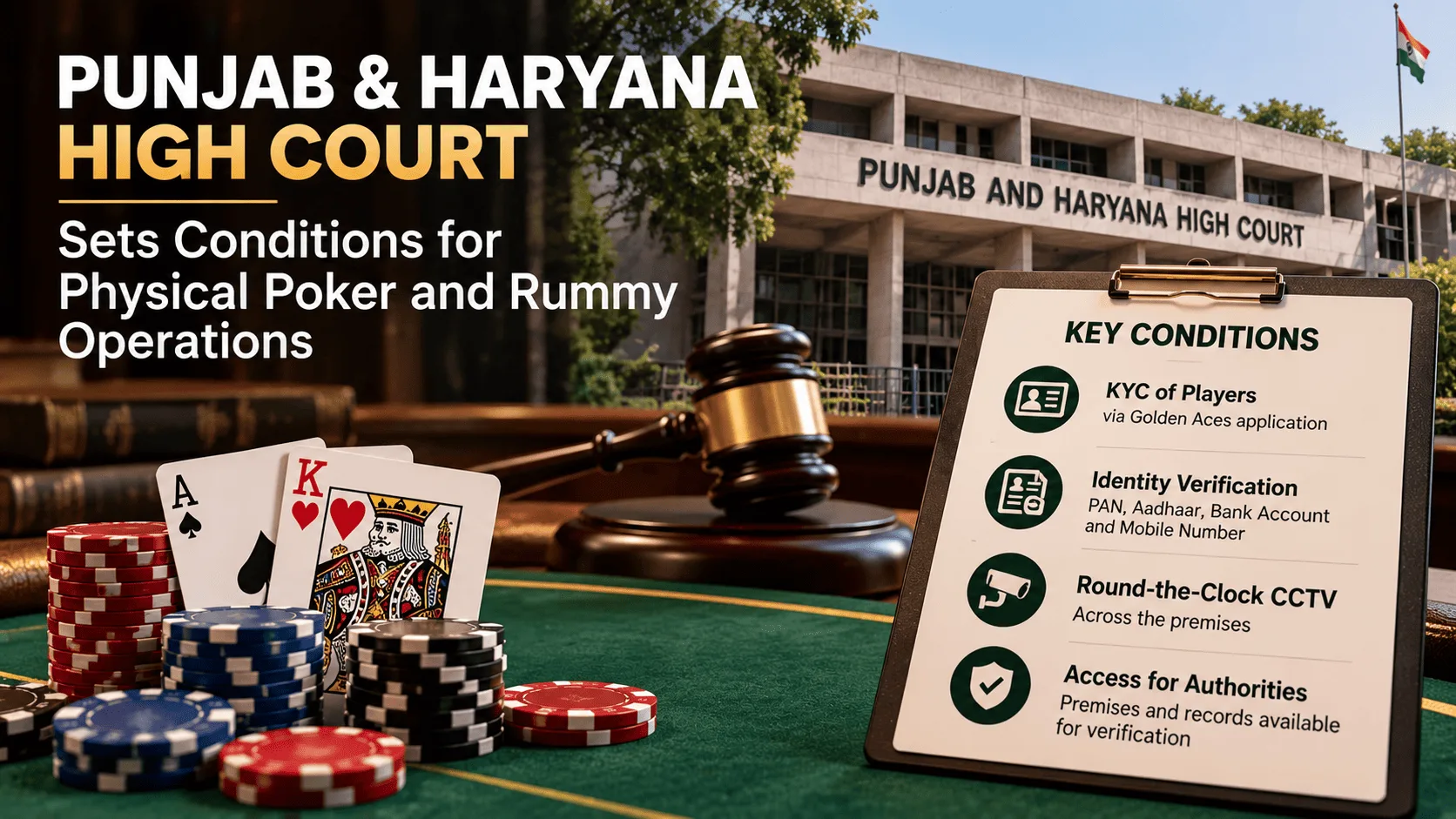
A separate issue arose in proceedings before the Punjab and Haryana High Court in August 2026 concerning physical poker and rummy operations. The court's discussion of the notification position makes it particularly important to verify the exact sequence of events and any subsequent government action before publishing a definitive account.
What about charging rake in a private poker game?
Rake is a deduction from the pot or other charge associated with operating a poker game. It can be relevant when assessing whether a host or operator is earning money from the activity.
However, the precise legal consequences of charging rake depend on the applicable law and the facts. Do not assume that calling a deduction a service charge, table fee or expense contribution automatically makes it lawful.
For someone organising a private game in Gurugram or Faridabad, the prudent approach is to obtain legal advice before collecting money connected to running the game. A no-rake arrangement may reduce one important indicator of commercial profit, but it does not guarantee immunity from legal action.
For a broader explanation of the Haryana position, see our guide, Is Poker Legal in Haryana?
3. Noida and Ghaziabad: What Has the Allahabad High Court Said?
In Uttar Pradesh, the Public Gambling Act, 1867, as applicable in the state, is relevant to the regulation of common gaming houses. Section 12 excludes games of mere skill from the Act.
An important decision is DM Gaming Pvt Ltd v. State of Uttar Pradesh, reported as 2024 SCC OnLine All 5009.
In its September 2024 reporting on the case, the SCC Times coverage of the Allahabad High Court decision explained that the court directed the authorities to reconsider the refusal of permission for a gaming unit involving poker and rummy and pass a reasoned order.
The decision is relevant because it addressed the treatment of poker and rummy as games of skill. However, it should not be interpreted as a universal licence to operate poker clubs or as a ruling that every poker game in Uttar Pradesh is automatically lawful.
The court also recognised that authorities could take action if gambling occurred at a particular premises in violation of the law.
For readers in Noida and Ghaziabad, the distinction between a game of skill and a commercial gaming operation remains important. The legality of a particular arrangement depends on the applicable statutory provisions, the facts and any relevant permissions or restrictions.
For further information, consult the Uttar Pradesh entry on our legal page.
4. Private Poker Game vs Common Gaming House: What Facts Matter?
The phrase "private poker game" is not, by itself, a legal exemption. The circumstances of the game may help distinguish an informal social gathering from a premises being operated as a gaming business.
The following comparison illustrates factors that may be relevant to that assessment. It is not a legal test or a guarantee of legality.
Factor | More consistent with an informal social game | May raise greater legal concerns |
|---|
Host's earnings | Host takes no rake, commission or profit from the game | Host collects rake, a time charge or a fee connected to gaming |
Participants | Invite-only gathering of friends who know each other | Players are regularly recruited from public groups or advertisements |
Frequency | Occasional social gathering | Fixed schedule and organised commercial operation |
Premises | Ordinary residence used for a social gathering | Premises regularly maintained or rented to operate gaming activities |
Money handling | Players manage their own funds transparently | A central operator or banker handles funds as part of a business arrangement |
Entry arrangements | No charge for the opportunity to play | Entry or seat fees are collected as part of a gaming operation |
These factors should be considered together with the relevant statute. No single factor necessarily determines the legal outcome.
Does charging for food or drinks make a game illegal?
Not automatically. There is a difference between sharing the actual cost of refreshments and collecting money as a condition of participating in a game.
However, the label used for a payment is not conclusive. If a charge is linked to participation, generates a profit or forms part of a commercial gaming arrangement, it may require closer legal scrutiny.
Hosts should not assume that describing a payment as a snack contribution, table fee or operating expense settles the legal question.
Does a private residence automatically protect the host?
No. A game held in a private residence can still raise legal issues if the facts satisfy the relevant statutory provisions.
Likewise, the presence of poker cards, chips or money does not, on its own, resolve every legal question. The purpose of the premises, the way the game is organised, the applicable exemption and the circumstances of any search all matter.
5. Can Police Enter and Search a Private Poker Game?
The answer depends on the jurisdiction and the applicable legal provisions.
In Delhi, Section 5 of the Delhi Public Gambling Act, 1955 sets out a procedure for entering and searching a place suspected of being a common gaming house. It specifies the relevant authority, the need for credible information and grounds for believing that the premises are being used for that purpose, and the conditions under which a police officer may be authorised to enter.
Other jurisdictions have their own statutory provisions and procedural requirements.
It is therefore inaccurate to say either that police can raid any private poker game at will or that a private game can never be searched. The legality of police action depends on the applicable law, the grounds for action and the circumstances of the case.
If police arrive at a private game, participants should remain calm, avoid obstructing lawful action and seek legal advice. They should not destroy records, conceal evidence or provide false information.
6. What Should You Do If Police Arrive?
If police arrive at a poker gathering, take the situation seriously and avoid escalating it.
Remain calm and cooperative. Avoid physical confrontation or obstruction.
Ask for clarification. Where appropriate, ask which law and provision the officers are acting under.
Do not provide false details. Give accurate information when legally required.
Do not destroy evidence. Avoid deleting records, hiding gaming materials or interfering with a search.
Seek legal assistance. Contact a qualified lawyer promptly, particularly if property is seized, participants are detained or an offence is alleged.
Record relevant details lawfully. Keep track of the time, officers involved and any documents provided, without interfering with official duties.
The Delhi Public Gambling Act contains a specific provision addressing false names and addresses in Section 7. You should not assume that giving inaccurate information is a harmless way to handle an encounter.
The appropriate response depends on the circumstances. A lawyer can advise on the rights of the host and participants and the steps available to challenge an unlawful action.
Frequently Asked Questions
Is poker legal at home in Delhi?
The Delhi Public Gambling Act, 1955 targets common gaming houses and excludes games of mere skill under Section 13. An informal game among friends where the host takes no rake may present a different legal picture from a commercial gaming operation. However, the legality of a particular poker game depends on the facts and the applicable law. There is no blanket guarantee based solely on playing at home.
Is a private poker game legal in Gurugram?
Haryana's Prevention of Public Gambling Act, 2025 provides the relevant statutory framework. The position also depends on the game's classification, the way it is operated and the status of applicable notifications. Verify the current Haryana Gazette position and seek legal advice before organising a game involving money.
Can police raid a private poker game?
Police may have statutory powers to enter and search premises suspected of being a common gaming house when the relevant legal conditions are satisfied. The existence and scope of those powers depend on the jurisdiction, applicable law and circumstances. A private address alone does not guarantee that a search cannot occur.
Does taking a small rake to cover snacks change the legal position?
It can be relevant. A deduction from pots or a payment connected to participation may be evidence of profit or commercial operation, depending on the circumstances. Sharing actual refreshment costs is not necessarily equivalent to taking rake, but the substance of the arrangement matters more than the label. Seek legal advice if the host collects money connected to the game.
Does the Allahabad High Court decision make every poker game in Noida legal?
No. The DM Gaming decision addressed a particular dispute about permission for a gaming unit and the treatment of poker and rummy as games of skill. It should not be treated as blanket authorisation for every poker game or commercial venue in Uttar Pradesh.
Where can I find poker clubs in Delhi NCR?
You can explore our listings of poker clubs in NCR, including our Gurgaon poker clubs page. Before visiting a venue, verify its current operating status, permissions, game formats and entry conditions. A listing alone should not be treated as legal confirmation.
Conclusion
Whether police can raid a private poker game in Delhi NCR depends on more than whether the game takes place in a home or whether the players call it poker. The applicable gambling law, the status of the game as one of skill, the organisation of the premises and whether the host earns money from the activity can all be relevant.
Delhi's 1955 Act contains an exemption for games of mere skill and provisions governing common gaming houses and searches. Haryana has enacted a separate gambling law whose current notification position should be checked carefully. In Uttar Pradesh, the Allahabad High Court's 2024 decision concerning poker and rummy is relevant but does not create universal permission to operate gaming venues.
For players, hosts and venue operators, the safest approach is to understand the law that applies at the specific location, avoid assuming that private premises provide automatic protection and consult a qualified lawyer where money is being collected or a regular game is being organised.
Sources