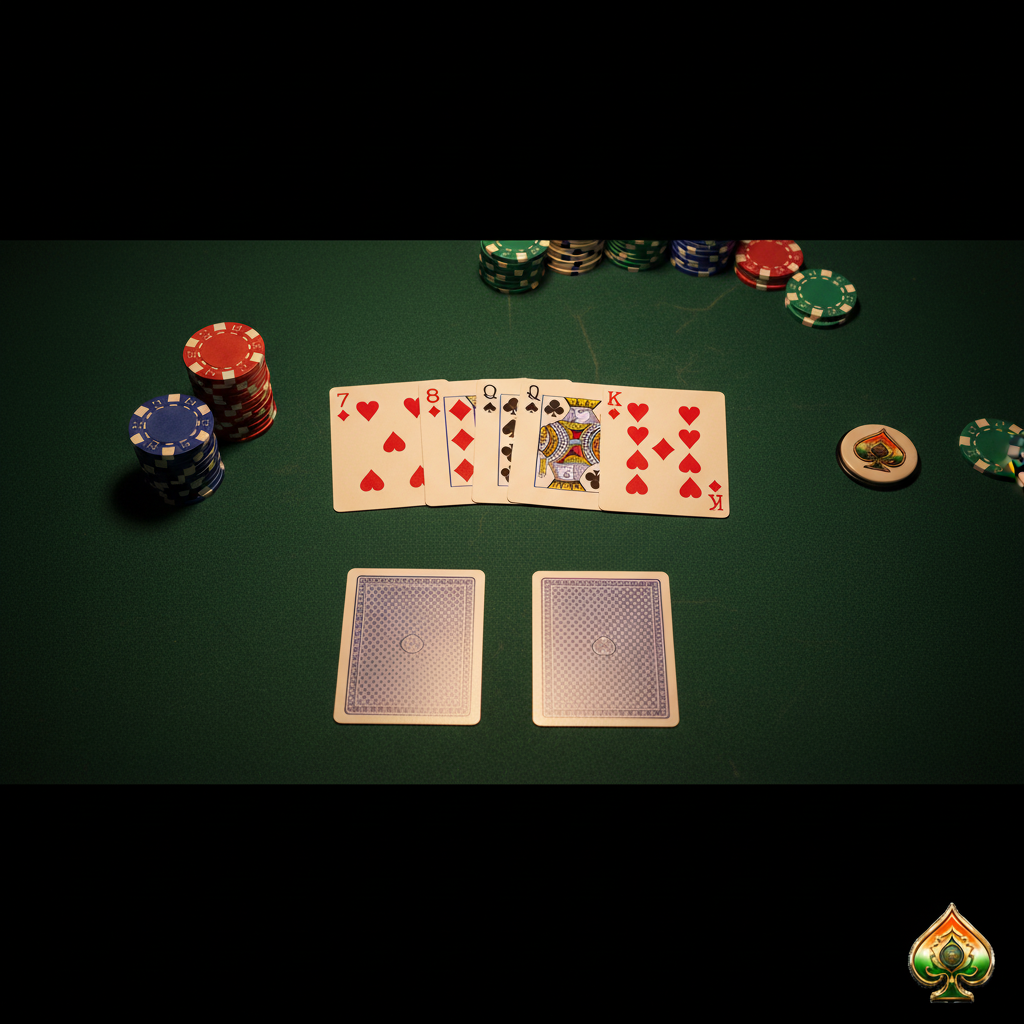
Learning how to play Texas Hold'em is straightforward once you understand the cards, betting rounds and poker hand rankings.
Each player receives two private cards, known as hole cards. Five community cards are then dealt face-up on the table across three stages: the flop, turn and river. Your goal is to make the best possible five-card poker hand using any combination of your two hole cards and the five community cards.
You can win the pot, which contains the chips or money wagered during the hand, in two ways: by having the best hand at showdown or by getting every other player to fold before the showdown.
Texas Hold'em combines strategy, probability, observation and decision-making with an element of chance. This guide explains the rules step by step, introduces the betting terminology and covers basic strategies to help Indian beginners understand the game.
Poker Hand Rankings: From Best to Worst
Before playing Texas Hold'em, learn the standard poker hand rankings. Knowing which hands beat others helps you evaluate your cards, understand your opponents' possible holdings and make better betting decisions.
The following table lists all ten standard hand categories, from the Royal Flush to High Card.
Rank | Poker Hand | Description | Example |
|---|
1 | Royal Flush | A, K, Q, J and 10 of the same suit | A♠ K♠ Q♠ J♠ 10♠ |
2 | Straight Flush | Five consecutive cards of the same suit | 9♥ 8♥ 7♥ 6♥ 5♥ |
3 | Four of a Kind | Four cards of the same rank | Q♠ Q♥ Q♦ Q♣ 7♠ |
4 | Full House | Three cards of one rank and a pair of another | J♦ J♠ J♣ 8♥ 8♣ |
5 | Flush | Five cards of the same suit, not in sequence | K♦ 9♦ 7♦ 4♦ 2♦ |
6 | Straight | Five consecutive cards of mixed or matching suits, but not all the same suit | 7♥ 6♠ 5♦ 4♣ 3♥ |
7 | Three of a Kind | Three cards of the same rank | 10♠ 10♥ 10♦ K♠ 2♣ |
8 | Two Pair | Two separate pairs | A♥ A♣ 5♠ 5♦ 9♥ |
9 | One Pair | Two cards of the same rank | K♠ K♦ Q♣ 7♥ 4♠ |
10 | High Card | No pair or higher-ranking combination | A♠ J♦ 8♣ 5♥ 2♠ |
A Royal Flush is the highest possible standard poker hand, while a High Card hand is the lowest category.
Remember that two players can have the same hand category. For example, a pair of aces beats a pair of kings. If players have the same pair, the remaining cards, known as kickers, can determine the winner.
How to Play Texas Hold'em: A Step-by-Step Guide
A standard hand of Texas Hold'em has four betting rounds: pre-flop, flop, turn and river. If at least two players remain after the final betting round, the hand proceeds to showdown.
Before the cards are dealt, a marker called the dealer button identifies the nominal dealer position for that hand. The button moves one seat clockwise around the table after each hand, rotating the positions fairly.
The two players immediately to the left of the button post forced bets called blinds:
Small blind: The first forced bet, usually half the big blind.
Big blind: The second forced bet, typically the standard minimum opening bet for that game.
For example, in a ₹10/₹20 cash game, the small blind is ₹10 and the big blind is ₹20.
These forced bets create an initial pot and give players a reason to compete for the chips.
Step 2: Pre-Flop Betting
Once the blinds have been posted, every player receives two private hole cards face-down.
The first betting round is called pre-flop. Action begins with the first player to the left of the big blind, commonly called the under-the-gun position.
Depending on the action so far, players can choose to:
Fold: Give up their hand and stop participating in the pot.
Call: Match the amount required to continue.
Raise: Increase the current bet, subject to the game's minimum raise and betting rules.
For example, if the big blind is ₹20 and nobody has raised, a player can call ₹20 or raise to at least ₹40 under standard no-limit rules.
Betting continues around the table until all remaining players have matched the current bet or folded. If nobody raises, the big blind generally has the option to check or raise when action returns to them.
Step 3: The Flop
After pre-flop betting finishes, three community cards are dealt face-up in the middle of the table. This is called the flop.
All remaining players can use these cards alongside their hole cards to form the best possible five-card hand.
A new betting round begins with the first active player to the left of the dealer button.
Players can:
Check: Pass the action without betting, provided no bet has been made in the current round.
Bet: Put chips into the pot when no bet has been made.
Call: Match an existing bet.
Raise: Increase an existing bet.
Fold: Give up the hand.
The flop often changes how strong a starting hand looks. For example, a player holding two hearts may develop a flush draw if the flop contains two more hearts.
Step 4: The Turn
After flop betting is complete, a fourth community card is dealt face-up. This is known as the turn or Fourth Street.
Another betting round follows, using the same general betting actions as on the flop.
At this stage, players have more information about the possible hands their opponents may hold. A pair might improve to three of a kind, a straight draw might complete, or a flush could become possible.
However, the turn can also strengthen an opponent's hand. Evaluate the entire board rather than focusing only on your own cards.
Step 5: The River
The fifth and final community card is dealt face-up. This is called the river or Fifth Street.
All five community cards are now visible, and the final betting round begins with the first active player to the left of the dealer button.
Players must decide whether their hand is strong enough to bet for value, whether a bluff is appropriate, or whether folding is the better decision.
Once the betting round ends, the hand proceeds to showdown if two or more players remain.
Step 6: The Showdown
At showdown, the remaining players reveal their hole cards according to the game's showdown procedures. Each player makes the best possible five-card hand from their two hole cards and the five community cards.
The player with the highest-ranking hand wins the pot.
For example, suppose you hold A♥ K♠ and the board is A♣ 5♥ 9♦ K♣ J♠. Your best five-card hand contains two pair: aces and kings, with a jack as the kicker.
If two or more players have equally ranked five-card hands, the pot is split equally among them, subject to the game's rules and any indivisible chip.
After the pot is awarded, the dealer button moves one position clockwise, and the next hand begins.
Understanding Texas Hold'em Betting Actions
Poker has its own terminology. Understanding these five basic actions will help you follow the game and make decisions confidently.
Action | What It Means | Example |
|---|
Check | Pass the action without betting when no bet is outstanding | You check when nobody has bet on the flop. |
Bet | Make the first wager in a betting round | You bet ₹500 into the pot. |
Fold | Give up your hand and forfeit any claim to the pot | You fold when an opponent makes a bet you do not want to call. |
Call | Match the amount of the current bet | An opponent bets ₹500, and you call ₹500. |
Raise | Increase the current bet, following the applicable betting rules | An opponent bets ₹500, and you raise to ₹1,000 if that raise is legal. |
In no-limit Texas Hold'em, a player can generally bet any amount up to their available chips, subject to the game's minimum-bet and raise rules. In pot-limit games, the maximum bet is restricted by the size of the pot.
For beginners, the most important distinction is simple: checking costs nothing extra, calling matches a bet, raising increases it, and folding ends your participation in the hand.
Basic Texas Hold'em Strategy for Beginners
Knowing the rules is only the starting point. Good decisions also depend on your position, starting-hand selection, opponents' actions and the amount you are risking.
1. Understand Why Position Matters
Your position determines when you act during a betting round.
Players in early positions must make decisions before most of their opponents. Players in later positions have more information because they can observe earlier actions.
The dealer button is particularly valuable because the player on the button acts last on the flop, turn and river when still in the hand.
As a beginner, try to play more selectively from early positions and take advantage of the additional information available in later positions.
2. Be Selective With Your Starting Hands
You receive two hole cards before the flop, but not every starting hand is worth playing.
Strong starting hands often include:
High pocket pairs such as A-A, K-K and Q-Q.
Strong high-card combinations such as A-K and A-Q.
Well-connected suited cards, such as 8♥ 7♥, which can make straights and flushes.
The best decision also depends on your position, the number of players, previous raises and the effective stack sizes.
Avoid playing every hand simply because you want to see the flop. Folding weaker starting hands can save chips for more favourable situations.
3. Do Not Be Afraid to Fold
One of the most common beginner mistakes is continuing with a hand simply because chips have already been invested.
Money placed in the pot earlier cannot be recovered by calling another bet unless you win the pot. Your decision should focus on whether continuing is worthwhile based on the current situation.
If your hand is weak, the board is dangerous, or an opponent's betting strongly suggests a better hand, folding may be the most sensible option.
A disciplined fold is part of sound poker strategy, not a sign of failure.
4. Observe Your Opponents
Poker involves making decisions with incomplete information. Paying attention to how opponents play can help you estimate their possible holdings.
Look for patterns such as:
Players who raise frequently before the flop.
Players who call often but rarely raise.
Players who bet strongly only when they appear to have a strong hand.
Players who frequently fold when facing pressure.
These observations are not guarantees of what someone holds. Use them as clues alongside the board, betting history and your own hand strength.
5. Manage Your Bankroll
Your bankroll is the money you have specifically set aside for poker. Good bankroll management helps you control financial risk and avoid playing with money needed for essential expenses.
Before joining a cash game:
Choose stakes that fit your budget.
Understand the blinds and minimum buy-in.
Set a limit for the session.
Avoid borrowing money to play.
Never chase losses by moving to higher stakes.
Stop if you are no longer making clear, considered decisions.
Poker combines skill with chance, and even strong players can lose over short periods. There is no strategy that guarantees a profit.
6. Learn Through Practice
Once you understand the rules and basic strategy, practise identifying hand rankings and following betting rounds.
You can also review poker hand examples, study beginner guides and observe how experienced players explain their decisions. If you plan to play in person, research the venue's entry requirements, game format and stakes before visiting.
For additional learning, explore our guides to poker hand rankings, poker tips for beginners and poker clubs near you, where relevant pages are available.
Is Poker Legal in India?
Poker's legal position in India depends on the applicable central and state laws, relevant court decisions and the specific format and circumstances in which the game is played.
Some jurisdictions have recognised distinctions between games of skill and games of chance, while others have specific restrictions that may affect gambling activities. The legal position can also differ between private games, commercial venues and online platforms.
Do not assume that poker is automatically legal or illegal everywhere in India. Before playing at a venue or organising a game, check the rules applicable in your state.
For more information, read our state-by-state guide to poker laws in India. This general guide is educational and should not be treated as legal advice.
Frequently Asked Questions
What is the best hand in Texas Hold'em?
The Royal Flush is the highest-ranking standard poker hand. It consists of an ace, king, queen, jack and ten, all of the same suit. It is extremely rare and cannot be beaten by any other standard hand.
What happens if two players have the same hand?
If two players have identical best five-card hands, they split the pot equally, subject to the game's rules. When the hand categories are the same but the card combinations differ, the higher-ranked combination wins. Kickers can determine the result when the main combinations are tied.
Can I use just one of my hole cards in Texas Hold'em?
Yes. You can use both hole cards, only one hole card or neither hole card. Your final hand must always consist of the best five-card combination available from your two private cards and the five community cards. Using all five community cards is known as playing the board.
The dealer button marks the nominal dealer position for the hand. It moves one seat clockwise after each hand, helping rotate the small blind, big blind and other positions around the table.
How much money do I need to start playing Texas Hold'em?
The amount depends on the game's stakes, minimum buy-in and your personal budget. Some games use very small blinds, while others require much larger buy-ins. Beginners should choose stakes they can comfortably afford and never play with money needed for essential expenses.
Is Texas Hold'em difficult for beginners?
The basic rules are relatively easy to learn, but mastering strategy takes practice. Start by memorising hand rankings, understanding the betting rounds, choosing starting hands carefully and learning when to fold. Experience helps you improve your decisions over time.
Conclusion
Texas Hold'em is a widely played poker format built around two private cards, five community cards and four betting rounds. Once you understand hand rankings, the blinds and the basic betting actions, you can follow a hand from the pre-flop stage to showdown.
For beginners in India, the next step is to practise evaluating starting hands, understand the importance of position and manage your bankroll carefully. Avoid playing every hand, pay attention to opponents' actions and remember that no strategy can guarantee a win.
Before playing for real money, make sure you understand the rules and the laws applicable to your location. Poker involves skill as well as chance, so play responsibly and only risk money you can afford to lose.