India’s poker laws are an important topic for players, club owners, and tournament organisers. The legal position depends on the type of game, where it takes place, and which laws apply. A rule for online gaming may not apply in the same way to a physical poker club
In 2026, online gaming regulation has become a major part of the discussion. The Promotion and Regulation of Online Gaming Act, 2025, along with the related 2026 Rules, introduced a national framework for online games. At the same time, physical poker venues must consider the laws and requirements that apply in their own states.
This guide explains the main legal changes, what players should check before joining a game, and how to approach poker clubs and tournaments more carefully.
What Are the Latest Poker Law Updates in India?
One of the most important developments is the Promotion and Regulation of Online Gaming Act, 2025. The central government published the related Online Gaming Rules, 2026, which came into force on 1 May 2026.
The framework distinguishes between different types of online gaming. It promotes esports and online social games while prohibiting online money games under the Act. The prohibition covers games involving money or other stakes with an expectation of monetary winnings, including games based on skill, chance, or a combination of both.
This is important because a game cannot be treated as legally permitted simply because players believe it requires skill.
However, the online gaming framework should not be confused with the rules governing every physical poker venue. Offline clubs may be subject to separate state laws, local permissions, and other legal requirements.
Players and operators should read the relevant law rather than rely only on social media posts or older articles.
Does Indian Law Treat Poker as a Game of Skill?
Poker involves several skills. Players make decisions based on their cards, betting patterns, probability, and the actions of other players. Experience and strategy can influence the way a player performs.
However, the legal treatment of poker is not uniform across India.
In the past, some court decisions considered skill-based arguments when examining poker and other card games. But this does not mean that every poker format is permitted in every state.
The legal position may depend on the applicable statute, the type of game, whether money is involved, and whether the activity takes place online or at a physical venue.
The distinction is especially important in 2026. The central online gaming law prohibits online money games within its scope, even where a game is described as skill-based.
Therefore, players should not assume that poker is automatically legal everywhere because it requires strategy. Club operators should also obtain advice on the specific laws that apply to their venue and business model.
Online Poker and Physical Poker Clubs: Know the Difference
Online poker and physical poker clubs may appear similar, but their legal requirements can differ.
Online poker
The Promotion and Regulation of Online Gaming Act, 2025, establishes a framework that prohibits online money games. It also addresses their advertising, promotion, facilitation, and related financial transactions.
The 2026 Rules provide procedures for classifying online games and regulating permissible categories.
Players should check official government updates before using an online platform. An old licence claim, a popular brand name, or a description such as “skill game” should not be treated as proof that a real-money service is permitted.
Physical poker clubs
Physical poker clubs operate in a different setting. Their legal position depends on the relevant state laws and the permissions required for the premises and activity.
Before visiting a venue, players should check its current operating status, published rules, and available information about its registration or permissions.
A physical club should not be assumed to be legal simply because it appears in an online directory. Equally, the online money-game prohibition should not be presented as a blanket statement that every physical poker venue in India is prohibited.
The correct approach is to examine the specific activity and the law that governs it.
What Should Players Know About Poker Tournaments in India?
Poker tournaments in India attract players who enjoy structured games, set starting stacks, and competitive formats. However, the legal status of a tournament cannot be determined by its name alone.
Before entering an event, players should consider the following points.
Check the tournament format. Understand whether the event is played online or at a physical venue. This distinction can affect which legal framework applies.
Review the entry conditions. Read the published terms, entry fees, prize structure, and payment conditions. Do not assume that a tournament is permitted simply because its rules are clearly written.
Confirm the organiser’s details. Look for the organiser’s identity, contact information, venue details, and relevant permissions. If important information is missing, ask for clarification before paying.
Check current legal updates. Laws and court decisions can change. Information from an old tournament listing may no longer reflect the current position.
Keep records. Save entry confirmations, receipts, published terms, and communications with the organiser. These records may be useful if a dispute arises.
These checks can help players make informed decisions. They do not replace legal advice or guarantee that a particular tournament is lawful.
What Must Poker Club Operators Consider?
Club operators need to look beyond the popularity of poker or the demand for live games. Legal compliance should be part of the planning process from the beginning.
First, operators should identify the state and local laws that apply to their premises and activities. They should confirm whether the proposed format is permitted and whether specific licences, registrations, or permissions are required.
Second, operators should review their business arrangements. The way a venue collects fees, manages player funds, awards prizes, or promotes events may affect its legal obligations.
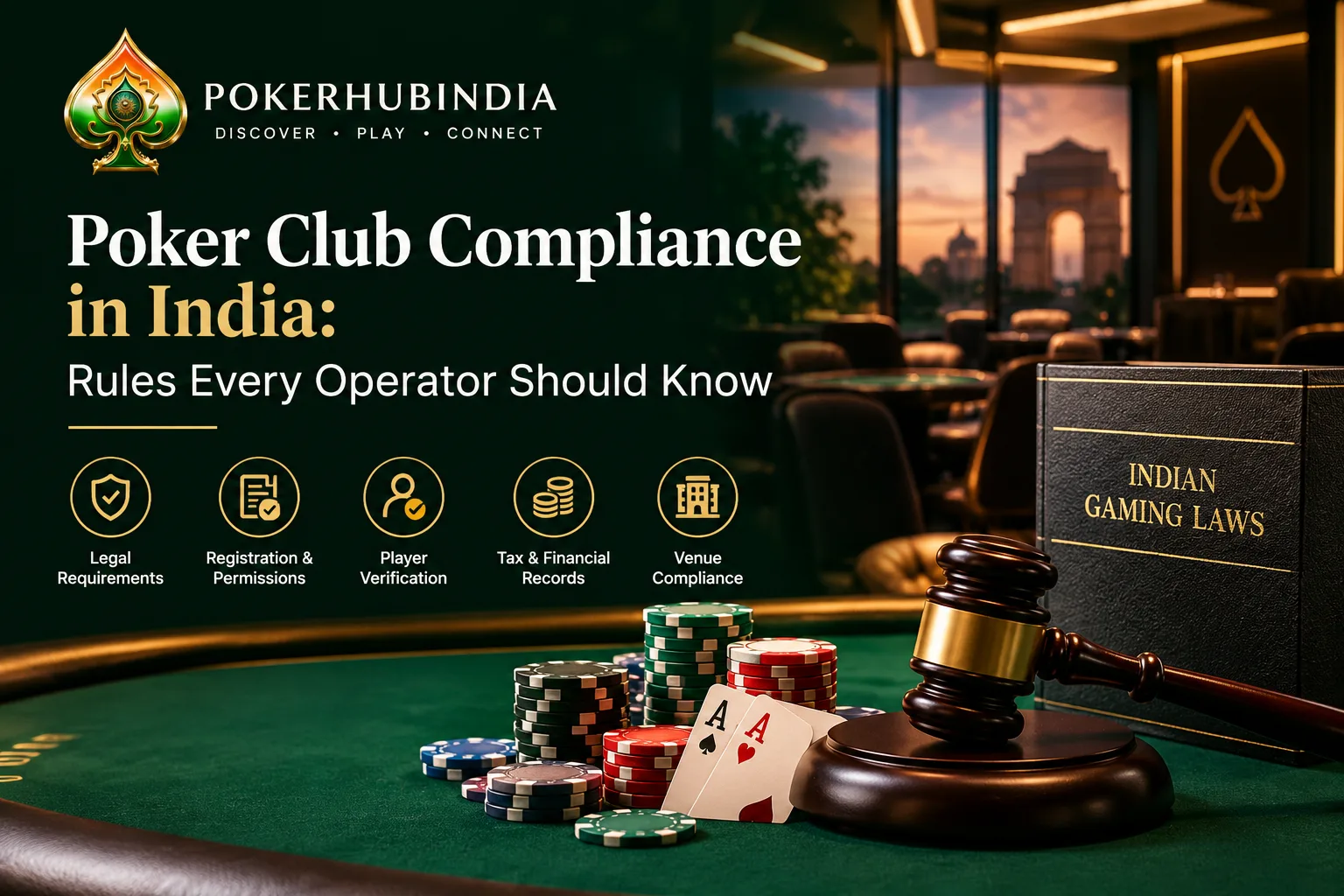
Third, operators should maintain accurate records and transparent procedures. Depending on the applicable rules, requirements may involve identity checks, financial records, security measures, tax compliance, and cooperation with relevant authorities.
Online gaming businesses must also examine the central online gaming framework and its applicable restrictions. A physical venue and an online service should not assume that the same compliance checklist covers both.
Because the legal position can vary, operators should seek advice from a qualified lawyer familiar with gaming laws in the relevant state.
How to Find Verified Poker Clubs Safely
People searching for poker clubs near me often want clear details about live venues, available games, locations, and entry requirements. Finding a listing is a useful first step, but players should also check whether the information is current.
Here are some practical ways to assess a venue.
Verify the address and contact details. Check that the listed location matches the venue's current information. Contact the club before travelling if its details are unclear.
Ask about the game format. Confirm what type of poker is offered, how entry works, and whether the venue has published rules for players.
Check relevant permissions. Where applicable, ask the operator for information about its registration or legal authorisation. Do not treat a directory listing as a legal certification.
Review fees and policies. Understand any entry charges, cancellation conditions, age requirements, and player conduct rules before participating.
Look for recent information. Old photographs, outdated opening hours, and expired event listings can create confusion. Current details are more useful than unsupported claims.
PokerHubIndia helps readers explore poker venues and learn about India's live poker scene. Its Verified Poker Clubs content and venue listings should be used as a starting point for research, alongside independent checks of current venue details and applicable legal requirements.
A listing can help people discover a venue, but it should not be treated as a guarantee of legal status unless that status has been properly established.
Why Poker Laws May Differ Across Indian States
India's poker landscape cannot be understood through one simple rule for every venue.
State gambling laws, court decisions, local requirements, and the distinction between online and physical gaming can all matter. A legal development in one state does not automatically establish the same position in another.
For example, a venue may need to consider the law governing its location as well as any applicable central legislation. The operator must identify which requirements apply to the particular activity rather than relying on a general statement about poker being a game of skill.
Players who travel between cities should also avoid assuming that rules remain the same from one destination to another.
For reliable information, consult official government notifications, the text of relevant legislation, and applicable court judgments. When the legal position is uncertain, obtain professional advice before participating in or operating a game.
Frequently Asked Questions
1. Is poker legal in India in 2026?
There is no single answer for every form of poker. Online money games are prohibited under the Promotion and Regulation of Online Gaming Act, 2025. Physical poker activities may be governed by separate state laws and other applicable requirements.
2. Are online poker games allowed in India?
The 2025 Act prohibits online money games within its scope, including games involving skill, chance, or both. Players should check the official rules and current government guidance rather than rely on a platform's marketing claims.
3. Can I visit a physical poker club in India?
The answer depends on the state, the venue, and the activity being offered. Check the applicable law, current venue information, and any necessary permissions before participating.
4. How can I find poker clubs near me?
Search for local venues, check their contact details, and confirm that their information is current. Review the game format and ask about applicable permissions before visiting.
5. Are poker tournaments in India legal?
The answer depends on the format, location, and applicable laws. A tournament's name or skill-based format does not automatically establish that it is legally permitted.
6. What does Verified Poker Clubs mean?
The term can describe a directory's approach to checking venue information. It should not automatically be interpreted as government approval or legal certification. Readers should confirm what verification has actually been performed.
Final Thoughts
India's poker laws in 2026 require careful attention to the difference between online money games and physical poker venues. The central online gaming framework introduces significant restrictions, while the rules affecting physical clubs may depend on the state and the activity involved.
Players should check tournament conditions, venue details, and relevant legal requirements before participating. Operators should obtain appropriate legal advice and keep their compliance information current.
PokerHub India aims to help readers explore India's live poker scene through venue information and useful guides. By combining reliable listings with careful legal research, players can make better-informed decisions about where to learn about poker clubs and upcoming events.