Can You Play Poker in Hyderabad? Telangana's Law Explained
A practical guide to poker in Hyderabad, Telangana's restrictions, India's online money-game ban and the difference between a meetup and legal play.
Rishi Published 20 November 2026 11 min read
Share
On this page
The short answer
If you are searching for poker in Hyderabad, do not assume that a local poker group, private invitation or accessible website makes a real-money game lawful. Telangana had already been identified as a state enforcing restrictions on online gaming before India's 2025 national prohibition on online real-money games. Hyderabad does have a visible poker community, but the sources reviewed here do not establish a licensed Hyderabad casino or poker room where real-money poker can lawfully be offered.
The distinction matters because Indian gambling law is not one simple national rule. The 2026 ICLG gambling-law review says casino games and other forms of gaming have historically been governed by state-level laws. It also says the legal treatment of poker and skill games is not uniform across states. Separately, sources covering the 2025 national legislation report that online real-money gaming, including poker, is now prohibited nationally.
For a Hyderabad player, that leaves several different questions that should not be collapsed into one: Is the game online or face to face? Is money or another stake involved? Is somebody organising or operating the game commercially? Is the venue authorised? A social poker meetup is not evidence that a cash game is legal. Nor does poker's treatment as a skill game in some parts of India create an automatic Telangana exemption.
This article explains what can safely be concluded from the available sources, where the evidence stops, and what you should verify before putting money into a game. For a dedicated state reference, see our Telangana poker law page.
Poker in Hyderabad: community does not equal permission
There is clearly interest in poker Hyderabad-wide. Meetup's India poker directory lists a group called “Poker Hyderabad” in Hyderabad with 187 members in the supplied listing. The broader directory covers groups interested in formats including Texas Hold'em and seven-card stud. That is useful evidence of a local poker community. It is not evidence that members are running lawful real-money games, and nothing in that listing should be read as a licence or regulatory approval.
That is the first practical filter for anyone invited to a Hyderabad game. A listing can tell you that a group exists. It cannot answer the legal questions that matter when money enters the picture. The supplied Meetup page does not establish stakes, operating arrangements, licensing, legal status or even the precise format of any particular Hyderabad gathering.
This distinction is especially relevant because India's regulated live casino geography is limited. The gambling overview supplied for this article identifies casino operations in Goa, Daman and Sikkim. The ICLG review likewise discusses regulated land-based casino gaming in Goa, Daman and Diu and Sikkim. Neither source identifies Hyderabad as a licensed casino destination.
So a claim such as “there is a poker community in Hyderabad” has source support. A claim such as “there are legal cash poker clubs in Hyderabad” does not follow from it. If somebody advertises a club, tournament or home game locally, ask the organiser directly what legal basis they rely on and independently verify that claim. Do not treat membership numbers, social-media posts, an entry fee or a professionally dealt table as proof of legality.
Hyderabad has a visible poker community, but a social listing does not establish that real-money play is legally authorised.
What does the Telangana gaming law mean for poker?
Searches for “Telangana gaming act” often lead to a deceptively simple question: does Telangana ban poker? The material available here supports a more qualified answer than a blanket yes or no.
The 2026 ICLG review explains that gambling regulation in India has substantially operated through state gaming laws. Its poker section says skill variants of poker are not expressly prohibited under other state gaming laws outside the licensing regimes it discusses for Sikkim and Nagaland. In the same discussion, however, it warns that the judicial position on poker as a skill game is not uniform across all states. That warning matters. A general statement about skill poker in India cannot simply be transplanted into Hyderabad without examining Telangana's own law and the particular activity.
Another supplied source, SoMuchPoker's October 2026 India guide, says Telangana was among the states that were already enforcing their own bans before the national online real-money gaming prohibition. A historical Quora answer also describes Telangana action against online gambling, but it is a user-generated account and does not provide a sufficiently reliable basis here for stating detailed statutory provisions or penalties.
That is why this article does not quote a Telangana section number, prescribe a supposed private-game exemption or claim that calling a tournament “skill poker” settles its legality. Those details are not established by the supplied primary material. Anyone making a decision involving money, a club, rake, tournament fees or commercial organisation should consult the current statutory text and, where necessary, obtain legal advice.
The useful takeaway is narrower: Telangana's own rules matter, poker's skill classification is not uniform nationally, and the existence of skill-game decisions elsewhere is not by itself permission to run or join a money game in Hyderabad.
Online poker: the national rules changed in 2025
Online poker requires a separate analysis because the national position changed materially in 2025. The supplied Wikipedia overview states that a national framework came into force under the Promotion and Regulation of Online Gaming Act, 2025, prohibiting online money games while regulating e-sports and online social games. SoMuchPoker likewise reports that federal legislation enacted in August 2025 prohibited online real-money gaming and says this included poker and fantasy sports.
That means an old article debating whether poker is predominantly skill is not enough to answer the current question about depositing money on an online poker site. The newer national prohibition concerns online money games. SoMuchPoker reports that major domestic operators and Natural8in.com stopped services following the change. Its account also says that offering, enabling or promoting online poker attracts legal consequences while users are treated as victims rather than offenders. Players should still consult the legislation or legal advice rather than infer their personal position from a summary article.
A practical example shows why dates matter. Suppose a Hyderabad player finds a 2023 discussion saying that poker should qualify as a game of skill. That material predates the reported 2025 federal online-money-game regime. It therefore cannot, on its own, establish that depositing ₹1,000 into an online poker game is lawful today. Changing the deposit to ₹500 does not answer the legal question either; the sources supplied here do not describe a monetary threshold that makes an online money game permissible.
Likewise, technical access is not legal authorisation. A website loading on your phone, accepting registration or being reachable from Telangana does not demonstrate compliance with Indian law. The relevant question is what activity the current law permits, not whether the technology allows you to reach it.
Live poker and online poker are not the same legal question
Players often use “poker legal in India” as though it describes one activity. The sources show why that shortcut is risky. The ICLG review separates online and land-based forms and says casino games are governed by state-level laws. For physical poker, it notes that certain High Courts have recognised certain variations as games of skill, while expressly cautioning that this position is not uniform across states.
The 2025 national online legislation adds another layer. SoMuchPoker describes the national restriction as an online real-money gaming ban while saying live poker remains available in sanctioned states, particularly Goa and Sikkim. Its venue discussion identifies those places as the main live poker hubs. The broader gambling overview also lists casinos in Goa, Daman and Sikkim.
Consider two scenarios. In the first, four friends meet in Hyderabad to practise Hold'em using chips that have no stated monetary stake. In the second, an organiser advertises a cash game, takes money and operates it from physical premises. They may both look like poker at the table, but they raise different legal and factual issues. The supplied sources do not give enough detail to declare the first arrangement exempt under Telangana law, and they certainly do not establish the second as licensed merely because poker can involve skill.
A third scenario is different again: the same player opens an online real-money table from a Hyderabad flat. That engages the post-2025 national framework described above as well as any relevant state rules. Location alone does not convert an online money game into a permitted live one.
For players, separating these formats before searching for an answer avoids relying on a court discussion, club advertisement or casino rule that concerns a different kind of poker altogether.
Checks to make before joining a Hyderabad game
When somebody offers a poker game in Hyderabad, focus on verifiable facts rather than labels. “Members only”, “private”, “skill game” and “tournament” may describe how an organiser presents a game, but the supplied sources do not establish that any of those labels creates a Telangana exemption. The same caution applies to a game promoted through a Meetup group. Meetup establishes community activity, not regulatory status.
A sensible due-diligence sequence is:
Establish whether the poker is online or played at physical premises. The legal sources distinguish between those forms.
Ask whether money or another financial stake is involved. Online real-money games are directly relevant to the national prohibition reported as taking effect in 2025.
For a physical venue, ask the operator what authorisation it relies on. Do not infer a licence from branding, dealers, membership rules or an invitation.
Check the current Telangana rules rather than relying on a generic Indian poker article. ICLG specifically cautions that the treatment of poker is not uniform across states.
Check the date of anything you read about online poker. Material from before the 2025 national change may describe a legal environment that no longer applies.
If money, commercial operation or legal exposure is material to your decision, obtain advice on the current legislation rather than relying on a directory or news report.
There is also a useful source-quality check. An operator's claim describes the operator's position; it is not the same thing as a regulator or statute confirming that position. A community listing proves that a community listing exists. A secondary legal guide can help explain the framework, but it should not be turned into a section number or exemption it never states.
This discipline is particularly useful in Hyderabad because there is visible poker interest without supplied evidence of a licensed local casino poker market.
Does calling poker a game of skill settle the issue?
No. Skill is an important part of the legal discussion around poker in India, but the supplied evidence does not support the claim that every poker game is lawful everywhere simply because players make strategic decisions.
The ICLG 2026 report gives the clearest formulation in the supplied research. It says certain High Courts have recognised certain variations of poker as games of skill and therefore outside prohibitions applicable under the relevant state gaming laws. Crucially, it immediately qualifies that point: the position is not uniform across all states. It also identifies Nagaland as a state whose legislation recognises poker as a skill game within a licensing system, while Sikkim has its own regulated framework.
Those examples demonstrate why the word “skill” cannot do all the legal work. Recognition in one jurisdiction, or under one licensing regime, does not prove what Telangana permits. Nor does it tell you whether a commercial club, home arrangement and online platform are treated identically.
The national online change makes the distinction even sharper. According to the supplied 2026 sources, the 2025 framework prohibits online money games nationally. A player therefore cannot safely reason: “Poker involves skill, therefore online real-money poker must be allowed.” That argument ignores the newer legislation described by the sources.
For the search question “is poker legal in Telangana?”, the defensible answer is consequently format-specific. The available material identifies Telangana as having had restrictions affecting online gaming, while current national law adds a prohibition on online real-money games. For live poker in Hyderabad, the material does not establish a blanket permission or a licensed Hyderabad casino venue. Specific arrangements need to be checked against current Telangana law rather than decided by the skill label alone.
Online real-money poker and live poker raise different legal questions under the current Indian framework.
Frequently asked questions
Is poker legal in Telangana?
There is no sound basis in the supplied sources for answering that question with an unrestricted yes. ICLG says the position on skill variants of poker is not uniform across Indian states, while SoMuchPoker identifies Telangana among states that had restrictions before the 2025 national online-money-game prohibition. For a particular live game, players should check current Telangana law and the circumstances of the game.
Can you play online real-money poker from Hyderabad?
The current sources report a national prohibition on online real-money gaming under the 2025 framework, including online poker. The fact that a website can be reached from Hyderabad should not be treated as evidence that real-money play is lawful.
Are there poker players in Hyderabad?
Yes, there is evidence of a poker community. The supplied Meetup directory lists “Poker Hyderabad” with 187 members. That listing establishes interest and community presence, not the legality of any cash games that members may or may not organise.
Does Hyderabad have a licensed casino for poker?
The sources reviewed for this guide do not identify a licensed casino in Hyderabad. The supplied national gambling overview identifies casino operations in Goa, Daman and Sikkim, while ICLG discusses regulated land-based casino gaming in Goa, Daman and Diu and Sikkim. Readers should check directly with the relevant authorities before relying on any local venue's licensing claim.
Does poker being a skill game make a Hyderabad cash game legal?
Not automatically. ICLG reports that certain poker variations have received skill-game recognition from certain High Courts, but says the position is not uniform across states. The legality of a particular Hyderabad arrangement cannot be established merely by calling it skill poker.
Telangana's prohibition against online gaming is once more facing legal scrutiny, while the Madras High Court has issued a ruling concerning the fantasy sports platform, Dream11.
The National Company Law Appellate Tribunal (NCLAT) has declined Google's request to stay a penalty imposed by the Competition Commission of India (CCI) concerning its Play Store's in-app payment policies.
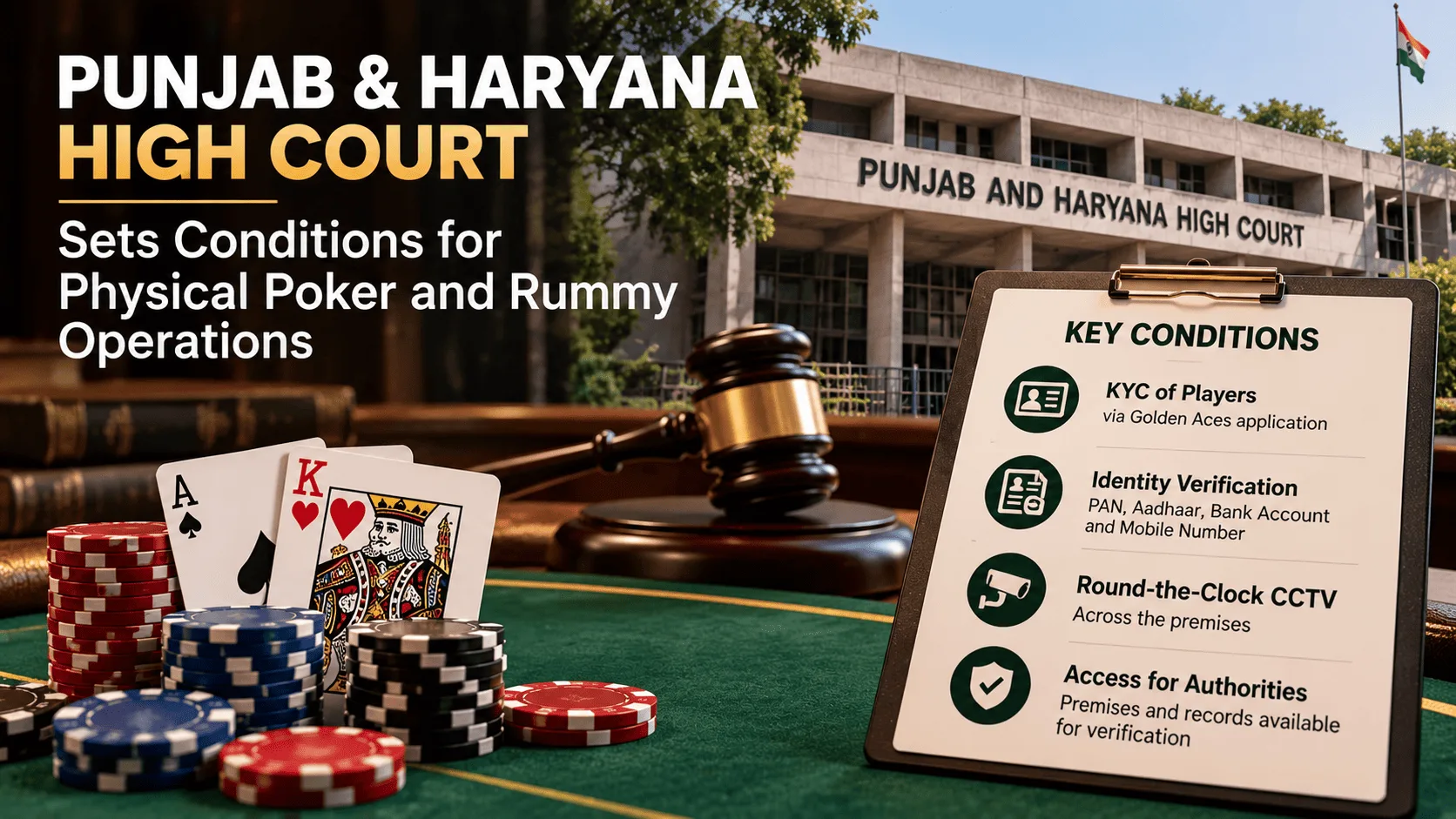
The High Court directed that specified petitioners be permitted to run physical poker and rummy, subject to KYC, traceability, CCTV and authority-access conditions.
Live poker now has a conditional legal route in Haryana. This guide explains the notification, club rules, court history, GST and the limits players should know.